Showing posts with label mythology. Show all posts

Friday, June 3, 2016

The Hidden Oracle by Rick Riordan

The Trials of Apollo: The Hidden Oracle by Rick Riordan -- Zeus needs someone to blame for the war with the giants, and his eye falls on Apollo. How do you punish a god? You make him mortal, of course. Apollo the scrawny teenager falls to earth in a New York City back alley, and immediately is set upon by thugs, then falls in with a young demigod who has some secrets she's not telling. Apollo wants nothing more than to regain his godly status, but how? He's got a sinking suspicion that it has to do with the Oracle of Delphi, which has been retaken by an old enemy of his. And, speaking of old enemies, some shadowy figures from the distant past seem to be making a bid for world domination. In fact, they may have been behind all of the troubles the demigods have faced thus far...

Just when I think Riordan has pretty much run through his source material, he manages to twist in a different direction and set off on a new course. Apollo's perspective is a lot of fun to read, what with the overweening egotism and all -- Riordan does make him somewhat sympathetic by the end of the book. And I'm intrigued by the new bad guys.

I didn't think this book was quite as action-packed as Riordan's other stuff, but it was doing a lot of work to set up the series. It was nice to go back to Camp Halfblood for a bit, and to see some old friends. I wouldn't recommend this as a starting point for readers new to Riordan, but fans of Percy Jackson should certainly take notice.

(Reviewed from my personally purchased copy.)

Friday, September 11, 2015

The Sword of Summer by Rick Riordan


The Sword of Summer by Rick Riordan is the first book in a new series rooted in Norse mythology.  This book will be released on October 6th, 2015.

Magnus Chase has been on his own since his mom died, living on the streets of Boston.  When his homeless buddies tell him that his uncle is looking for him, Magnus knows he's in trouble.  Soon, he finds himself in an action-packed chase-and-fight sequence that results in his death.  Now, usually it's not a good thing when a book's hero dies less than 50 pages into the story -- but Magnus has previously unsuspected ties to Norse mythology, so when he dies heroically, a Valkyrie whisks him away to Valhalla, where he joins the hordes of heroes awaiting Ragnarok.  There's just one problem: Magnus has some unfinished business on Earth.  Could it be that he's one hero that Valhalla just can't hold?

To me, this book feels like a return to Riordan's strengths.  While I enjoyed the Heroes of Olympus series, it did have some weaknesses -- particularly when it came to the sheer number of point-of-view characters.  This book zeros back in on a single first-person perspective (a friend who also read the book refers to Magnus as "an older, rougher Percy Jackson," and I think that sums him up pretty well, though there's still nothing content-wise to discomfit upper-elementary and middle-school readers).  Riordan also brings back the witty chapter titles that will have some readers (or at least this one) snorting with laughter at times.  The pace is a breakneck as ever, with the usual assortment of monsters and villains, just from further north this time.  Riordan works his usual magic with the mythology, seamlessly blending it into the modern world with plenty of tongue-in-cheek humor to hold everything together.  There are also a few sly references to Riordan's earlier works, not to mention a cameo appearance by a certain other Chase -- readers who haven't encountered those earlier books won't feel lost, but Riordan's fans will love those little inside jokes.  Bottom line: if you like Riordan's style, you'll definitely like this book -- and if you've never picked up the others, you can start here without worrying about what you've missed in earlier books. 

The only problem with reading an advance copy: it makes my wait for Book 2 that much longer!  Don't you feel sorry for me? . . . Nah, I didn't think so!

(Reviewed from an advance copy, courtesy of the publisher.)

Saturday, March 21, 2015

The Chosen Prince by Diane Stanley

The Chosen Prince by Diane Stanley is a tale of mythology and destiny.

The auguries at Prince Alexos' birth pointed to an interesting collection of traits: strength and weakness, wisdom and foolishness, virtue . . . and greatness. Is Alexos the chosen prince, prophesied long ago to heal a kingdom split apart by pointless war? When tragedy strikes, it seems as if Alexos cannot be the chosen one, after all -- but perhaps the goddess Athene still has other plans.

I wanted to like this book -- and I did, to some extent. I think the main barrier to my mind was the writing style. The author chose to use third-person present tense, and that unusual choice meant that the writing never got out of the way of the story; I was always aware of it, never fully immersed. I found the main characters satisfyingly complex, though some of the secondary characters (the king, for instance) were hardly more than stock characters. The plot moved along smoothly and I never felt that it was dragging, and the book deals with interesting themes of morality, destiny, and freedom. If you can get past the narrative perspective, I think this is a worthwhile read, particularly to readers who enjoy books set in the ancient world with overtones of mythology.

(Reviewed from an advance copy, courtesy of the publisher.)

Monday, October 27, 2014

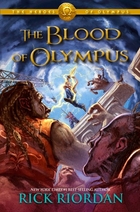
The Blood of Olympus by Rick Riordan

The Blood of Olympus by Rick Riordan is the conclusion of the Heroes of Olympus series.

The seven demigods of prophecy have come a long way over the course of the past four books. Now, as they travel through Greece to the final conflict, they fight battles both internal and external as they contemplate what certain lines of the prophecy may mean. Meanwhile, Nico, Reyna, and Coach Hedge struggle to transport the Athena Parthenos back to Camp Half-Blood in time to avert a deadly conflict between the Greek and Roman demigods. If they don't make it back in time, the consequences could be devastating. As the final battle looms, the fates of all of the characters in the story are far from certain.

This book, like its predecessors, is satisfyingly fast-paced and action-filled. All of the major plot points are wrapped up, though Riordan does leave a few tantalizing threads dangling, offering hope for perhaps a few more short stories featuring certain intriguing characters. I have just a minor criticism of this book, and since it constitutes a spoiler, readers who have not yet finished the book may want to stop reading here.

This may seem like a strange criticism, but nobody important died in the big final battle (unless you count Octavian, who had been set up as a minor villain since the first book). Despite two major conflicts raging, all seven (or nine, or ten if you want to count Nico, Reyna, and Coach Hedge) major characters lived. Which is great, but I honestly expected that at least one of the Seven would die in the last battle. In fact, though this series looks and feels more young adult (as opposed to juvenile) than the original Percy Jackson series, Riordan killed off more named characters in that series than in this one, by my count. It just feels a little cheap, especially in comparison with other major series for children and young adults. Everybody lives, everybody gets a love interest, nobody has to deal with consequences for an adventure of the scope of the one they've just had. Am I being a curmudgeon? If so, remember that I said this was a minor criticism -- I still enjoyed the series, and will probably enjoy more than one reread of it in the future.

(Reviewed from a copy borrowed through my library system.)

Thursday, June 26, 2014

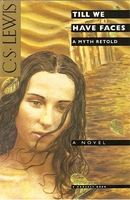
Till We Have Faces by C.S. Lewis

Till We Have Faces by C.S. Lewis is a retelling of the Cupid and Psyche myth from the perspective of Psyche's oldest sister.

Istra is the most beautiful child you can possibly imagine -- sweet and wholesome as a summer's day. You would think that her older half-sister Orual would hate her, but quite the opposite is true. Since Istra's mother died in childbirth and their father the king cares little for his female offspring, Orual is free to mother and care for Istra. Along with their tutor, a Greek slave known as the Fox, they wander the hillsides surrounding the city, happy and free. But all is not well in the kingdom: there are rumors of war with surrounding nations, wild animals ravaging the countryside, and now a plague in the city. The priest of the goddess Ungit casts the lots, and they fall to the king's household. Istra must be sacrificed, left on the holy mountain for the Shadowbeast. Orual is devastated to the point of sickness herself. When she is able to leave her bed, she resolves to go to the mountain and care for her sister's remains. What she finds there, however, is Istra alive and healthy. Istra has been living in a small valley high in the hills, but she claims that it is a castle, though Orual sees only rocks and bushes. Istra claims that she dwells in her husband's house -- the house of the god of the mountain. He comes to her at night, and she is forbidden to see his face. Orual tries to persuade Istra to come home, or to go into hiding with her, but Istra will not leave her mysterious lover. Orual eventually convinces Istra to at least light a lamp and see what sort of creature she has married -- surely, Orual thinks, either some monstrous beast or else a vagabond living wild in the hills, who has preyed on Istra's mind, weakened from the trauma of being sacrificed. Orual is sure that, once Istra sees her bridegroom, she will return to her sister's care. She waits at a distance, watching in the night for Istra's light to appear . . .

This is the book I like to recommend to people who think they know C.S. Lewis. It's much more nuanced and subtle than the Narnia stories (though, don't get me wrong, I am an avid fan of those as well), and I would contest that this book is his strongest literary work, and Orual his best female character by far. She's both a nurturer and a warrior, both strong and flawed. She's clever and bitter and not afraid to speak her mind. If you haven't read this book, either because you haven't heard of it, or because you wrote off C.S. Lewis for one reason or another, I urge you to go find this book and read it. Highly recommended.

(Reviewed from my personally purchased copy.)

Monday, March 10, 2014

Cruel Beauty by Rosamund Hodge

Cruel Beauty by Rosamund Hodge is a dark and complex retelling of Beauty and the Beast/Cupid and Psyche.

Nyx's father made a deal with the prince of demons, and now the time has come for that deal to be kept. Nyx will wed the Gentle Lord and live with him in his castle until she dies, in return for protection for the land and the life of her lovely twin sister. Nyx has known of her fate for most of her life -- and the bitterness and resentment that has built up within her has not been assuaged by the training her father has given her that may allow her to defeat the Gentle Lord and bring his reign to an end. She will take on the role of obedient wife, all the while searching the castle for the four "hermetic hearts" that hold the castle together. Nyx knows her duty -- but what she does not expect is the attraction she feels for her husband, the way the bitterness and malice within her seem to call out to the darkness and sarcasm in him.

Grounded in mythology and legend, this story hearkens back to the Cupid and Psyche myth that is the root of the Beauty and the Beast fairy tale. Elements of both make this the strongest Beauty and the Beast retelling I have read in quite some time. All of the characters are complex and thought-provoking, none entirely evil or entirely good. While I love a traditional Beauty and the Beast retelling where Beauty's purity of heart enables her to save the day, I found this version fascinating. Readers who enjoy classical mythology, complicated characterization, and new takes on traditional stories should certainly give this book a try.

(Reviewed from an advance copy, courtesy of the publisher.)

Thursday, December 5, 2013

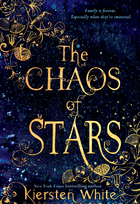
The Chaos of Stars by Kiersten White

The Chaos of Stars by Kiersten White is a fun, snarky read featuring Egyptian mythology in a modern setting.

Isadora is the mortal daughter of Egyptian gods, and she's kind of bitter about it. After all, what's the use of one mortal lifetime in comparison with her family's eternal years? In dealing with her moody teenage daughter while preparing for the birth of another child, Isis sends Isadora from Egypt to America to spend time with Sirus, Isadora's older (but also mortal) brother. But to keep her still involved with family concerns, Isis arranges for Isadora to volunteer at a museum that will be hosting an exhibit of art and sculpture belonging to Isadora's family. While working at the museum, Isadora makes friends with Tyler, a cheerful girl who is also volunteering there. She also meets handsome, brooding Ry -- but Isadora is determined not to fall in love, so she can just be friends with him, right? Life in California is not all parties on the beach and romantic tension, however: unexpected dangers await Isadora, and disturbing dreams point to trouble for her mother back in Egypt. Isadora is irritated at her mother, true, but she doesn't want any real harm to come to her . . . but who could harm a goddess?

This is a light, fluffy read, but it does a lot of things well. I'm no Egyptian mythology buff, but Isadora's brief explanations of life with her crazy family made the complex myths interesting and comprehensible to even a casual reader. The romance aspect of the plot was predictable but probably still enjoyable for most readers, and the mystery not too terribly obvious. Characters are well-written and likeable -- I was particularly fond of Sirus and Tyler. The dialogue and Isadora's snarky inner voice are the real stars of the book. If you like light reads with romance and mythology, and don't mind just a little teen angst, give this book a try.

(Reviewed from a copy borrowed through my library system.)

Friday, November 15, 2013

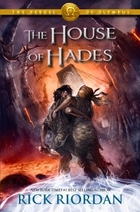
The House of Hades by Rick Riordan

The House of Hades by Rick Riordan is the fourth book in the Heroes of Olympus series. This review will contain some spoilers for earlier books in the series.

Gaea the earth goddess is waking, and this means trouble for all of the Olympians and demigods. As Jason, Piper, Leo, Hazel, Frank, and Nico fight to continue their quest, Percy and Annabeth struggle to survive in Tartarus. If both groups of demigods can arrive at the Doors of Death at the same time -- Percy and Annabeth from Tartarus, and the others from the human realm -- Percy and Annabeth can be saved, and the monsters can be stopped from constantly regenerating. But neither journey will be easy. . .

This series continues to be a lot of fun, packed with action and humor and a little bit of romance, too. The problem with having such a large cast of characters is that it's hard to give each of them time to shine, but I actually thought that was done better in this book than in the previous one. Frank, Hazel, Leo, and Nico each had nice moments of character development in this book, and since Percy and Annabeth were apart from the rest of the group, they also had plenty of page space. This book also manages to balance the series dynamic with the story arc of the individual book -- it's the penultimate book in the series, but it didn't feel like it was just there to build up to the final battle. I'm looking forward to The Blood of Olympus next fall, but I'll probably try to reread not only the Heroes of Olympus, but the Percy Jackson series as well, before that book's release.

(Reviewed from a copy borrowed through my library system.)

Tuesday, November 27, 2012

Starry River of the Sky by Grace Lin


Starry River of the Sky by Grace Lin is a lovely little book which incorporates Japanese folklore and mythology with a young hero's quest.

Rendi is running away from home, but when the merchant whose cart he was hiding in discovers his presence, Rendi is stranded in the tiny village of Clear Sky. Worse, every night his sleep is disturbed by a pitiful moaning sound: the sky mourning because the moon is missing. Rendi may be the only one who has noticed that the moon is gone. Is it because he, like the moon, is not in his proper place? Through the stories shared by the villagers and visitors to Clear Sky, Rendi will go on an introspective journey that will lead him to the point where he is able to share his own story -- and, yes, to find the missing moon in an unexpected place.

This book is a companion to the Newbery Honor-winning Where the Mountain Meets the Moon, and I found it just as charming. The two books feature different protagonists, and stand alone perfectly, but they also work beautifully together.

(Reviewed from a copy borrowed through my library system.)

Thursday, October 25, 2012

The Mark of Athena by Rick Riordan

In The Mark of Athena by Rick Riordan, the Prophecy of the Seven begins to come together as Percy, Annabeth, Jason, Piper, Frank, Hazel, and Leo are united in a quest that will take them across the ocean to Rome and beyond.

The quest does not begin smoothly. Mysterious forces are at work to ensure that the old conflict between the Greek and Roman demigods persists. The two camps seem to be on track for a deadly battle as the Seven travel together toward the Mediterranean, a sea that is home to legendary monsters and patently unfriendly to demigods. And conflict stirs in the angsty teenage hearts of the seven demigods who travel there, as well. . . .

So, of course I enjoyed this book. Naturally, I would recommend starting at the beginning of the Percy Jackson series and going from there, in order to appreciate all of the backstory, but fans of the series will find this book on par with its predecessors. A few caveats: the ending is more of a cliffhanger than we've seen so far -- not enough to be painful, but certainly enough to make me more than usually impatient for the next book. Also, as I rather snarkily implied above, there's more teenage angst in this book than in any of the earlier books -- mostly a product of putting seven teens together in a confined space, six of whom are couples at various stages in their relationships, and two of whom are boys who are used to being in positions of leadership, and don't take kindly to being put in second place in any given situation. Riordan has created seven strong and distinct characters, but not all of them get to be point-of-view characters in this story, which may disappoint some fans.

On the other hand, I'm always amazed at the depth and breadth of research that the author must do in order to keep coming up with authentic monsters, gods, and heroes to populate this series. I often booktalk the Percy Jackson books to parents and teachers as having a "sneaky educational" aspect to it -- I know I have learned stuff about Greek and Roman mythology from the series! I can't wait to see what happens to the characters in the next installment.

(Reviewed from a copy borrowed through my library system.)
Thursday, October 18, 2012

The Lost Hero and The Son of Neptune by Rick Riordan


The Lost Hero and The Son of Neptune by Rick Riordan were rereads for me, in preparation for reading the next book in the series.  Here's the review I wrote after my first reading of The Lost Hero:
 Jason, Piper, and Leo are not your average juvenile delinquents.  Leo may be ADHD and a chronic runaway from every foster home he's ever been sent to, but he also has a strange affinity for mechanical objects . . . and fire.  Piper may be a bit of a kleptomaniac -- or perhaps she's just really persuasive.  After all, is it really stealing if you can talk the sales clerk in to just handing you the merchandise?  And Jason . . . Jason doesn't really know who, or what, he is.  All he knows is that he woke up in the back of a schoolbus between Leo and Piper, and they seem to have been friends with him for months.  Jason doesn't remember any of it, or anything else about his life, including his last name.  There are some vague hints, including a mysterious tattoo and a heavy gold coin that turns into a sword when he flips it (a javelin, if it comes up tails), but before Jason can even piece together a few basic facts, he's in the middle of a fight with some nasty wind spirits on an observation platform over the Grand Canyon, and he, Leo, and Piper are fighting for their lives.  Fortunately, they are able to hold off until a back-up crew arrives, and they are whisked away in a flying chariot to a place called Camp Half-Blood.  Even there, however, Jason finds few answers to his many questions about his identity, his family, and his quest.

Fans of Riordan's Percy Jackson series will be ecstatic to pick up this first book in a new series about the demigods of Camp Half-Blood.  Many favorite characters make appearances, but in this book, the action follows the three newcomers -- and there's certainly plenty of action, as the three face new challenges on a  (sometimes literally) whirlwind quest to rescue the kidnapped goddess Hera before the Winter Solstice.  Meanwhile, the campers of Camp Half-Blood are preoccupied by the disappearance of Percy Jackson.  Clever, mythology-savvy readers will be able to piece together the mysteries of Jason's identity, Percy's disappearance, and Hera's capture (and yes, the three are all related) before the big reveal at the end, but whether they do or not, all of Riordan's fans are certain to enjoy the ride.  It's best, though not essential, to read the Percy Jackson series before starting this book, in order to obtain background information.

In The Son of Neptune, the focus shifts back to Percy Jackson, but he's not at Camp Half-Blood. Like Jason in The Lost Hero, Percy has lost most of his memories, and he finds himself at a camp that feels both right and wrong. Camp Jupiter is home to the demigod children of the Roman pantheon -- and Rome never had a lot of affection for Neptune and the sea. When Mars appears and issues a quest, Percy and two other misfit demigods set out for Alaska, known as "the land beyond the gods." In the far north, Percy and his companions won't be able to rely on help from their godly parents, and they face challenges from giants and monsters, as well as dealing with their own personal issues.

Like all of Riordan's books, this was a lot of fun to read. The new characters, Frank and Hazel, are sweet and likable. There is plenty of action, of course, and lots of Riordan's trademark humor (the part with the Amazons was my favorite). This is an enjoyable read for fans of the series.

(Reviewed from my personally purchased copies.)

Sunday, June 10, 2012

Starcrossed by Josephine Angelini

Starcrossed by Josephine Angelini is a fairly good read, though it has its weak points.

Nantucket native Helen Hamilton knows that she's different, but she doesn't know why. She's beautiful but painfully shy, and though she's both smart and athletic, she holds herself back in both areas so as not to draw attention. When the Delos family moves to the island and their teenage children start attending Helen's school, Helen finds herself consumed with an inexplicable burning hatred toward these newcomers. Helen's usually pretty easygoing, so her emotions come as a surprise to her and her friends. She even physically attacks Lucas, one of the Delos boys, in the hallway at school. Everything changes, though, when she and Lucas end up saving each others' lives. Helen learns that she is a demigod -- part of one of four rival families who have been battling since ancient times. And though Helen and Lucas are undeniably attracted to each other, they can never be together . . . the fate of the world depends on it.

So, this is sounding pretty Twilighty, right? A shy, beautiful girl, a mysterious family of beautiful people, a forbidden romance . . . I'd actually say it's Twilight meets Percy Jackson, and recommend it to people who enjoyed both of those series. It does have an edge over Twilight in a few ways, though. For one thing, Helen is as strong as the Delos family. They do some Cullen-esque protecting of her, but they also work on training her to use her gifts, and they acknowledge that she has the potential to be stronger than any of them. For another thing, Lucas is not as cold as a marble statue, he doesn't sparkle in the sunlight, and he has no desire to eat Helen. 'Nuff said, right? And I also appreciated that Helen doesn't completely dump her mortal friends for the Delos family. As for weaknesses, there are places where the writing is a little clunky, there are some weird perspective shifts toward the end of the book, after being pretty much in Helen's head for the bulk of the story, and Helen's passive attitude toward her training got on my nerves sometimes. Still, this was an enjoyable read which I'm sure I'll be recommending to teens looking for something similar to Twilight, and I'll probably read the sequel sooner or later.

(Reviewed from my personally purchased electronic copy.)